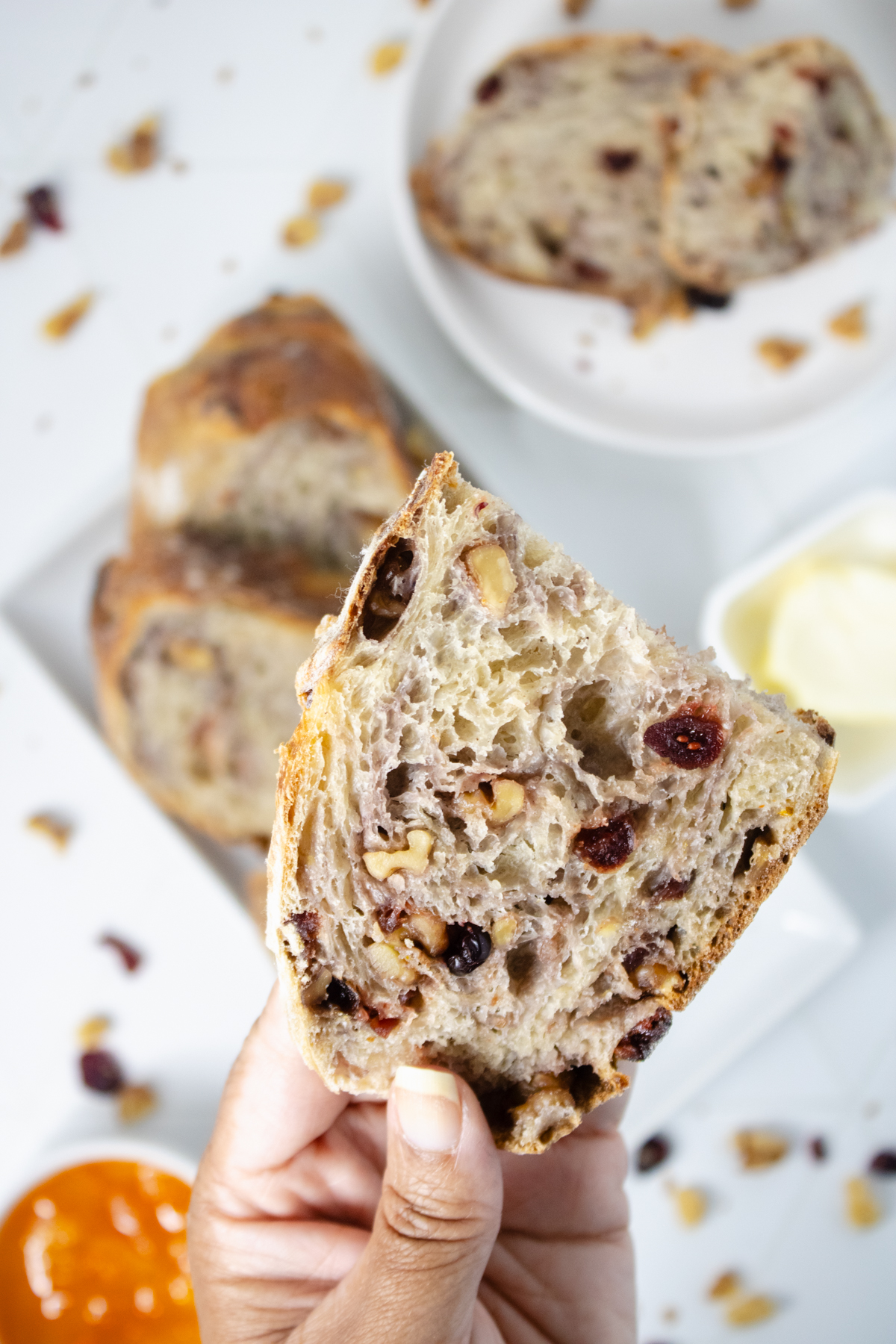
Ingredients
Equipment
Method
MIX AND REST
- Add the warm water, orange juice, sourdough starter, honey or maple syrup, and orange zest to a large mixing bowl. Stir until the starter is mostly dispersed.
- Add the bread flour, all-purpose flour, cinnamon, and sea salt. Mix until no dry flour remains. The dough will look shaggy and feel sticky. Cover the bowl with a damp towel and let the dough rest for 45 minutes.
- While the dough rests, place the dried cranberries in a small bowl and cover them with orange juice, apple juice, or water. If you prefer softer walnuts, soak them separately in warm water. Let the cranberries and walnuts soak for 30 minutes, then drain and pat them thoroughly dry.
INCORPORATE THE CRANBERRIES AND WALNUTS
- Add the cranberries and walnuts to the dough in three additions. After each addition, fold the dough over itself several times to enclose the inclusions. Continue until the cranberries and walnuts are evenly distributed. Cover and rest for 30 minutes.
BUILD STRENGTH AND BULK FERMENT
- With wet hands, lift one side of the dough, stretch it gently, and fold it toward the center. Turn the bowl and repeat on all four sides. This completes one set of stretch and folds.
- Repeat the stretch-and-fold process every 30 minutes for three to four additional sets. The dough should gradually become smoother, stronger, and better able to hold its shape.
- Cover the bowl and let the dough bulk ferment at room temperature for 6 to 8 hours. The dough is ready when it has nearly doubled, looks puffy and slightly domed, and shows visible bubbles along the surface or sides of the bowl.
SHAPE AND PROOF
- Lightly flour a clean work surface. Turn out the dough gently without pressing out all the gas. Form it into a loose round or oblong and let it rest for 5 minutes.
- Tighten the loaf by gently dragging it across the work surface. Place it seam side up in a floured banneton or a bowl lined with a well-floured towel. Cover and proof at room temperature for 2 to 4 hours. The dough should look puffy, and an indentation made with a lightly floured finger should spring back slowly.
BAKE THE BREAD
- Place the Dutch oven inside the oven and preheat to 450°F for at least 30 minutes.
- Turn the loaf onto parchment paper with the smooth side facing up. Score the top with a bread lame or sharp knife. Use the parchment to lower the loaf carefully into the hot Dutch oven.
- Cover and bake for 30 minutes. Remove the lid and continue baking for 20 to 25 minutes, until the crust is deeply golden and the center reaches at least 200°F.
- Use the parchment paper to lift the bread from the Dutch oven. Transfer it to a cooling rack and let it cool completely before slicing.